
Learn about Webel's comprehensive SysMLv2 Workshop Seminar course!
Webel now has a SysMLv2 Online Self-Study course with self-test Quizzes!
Learn about the Webel Q&A online self-testing system for SysML v2/v1

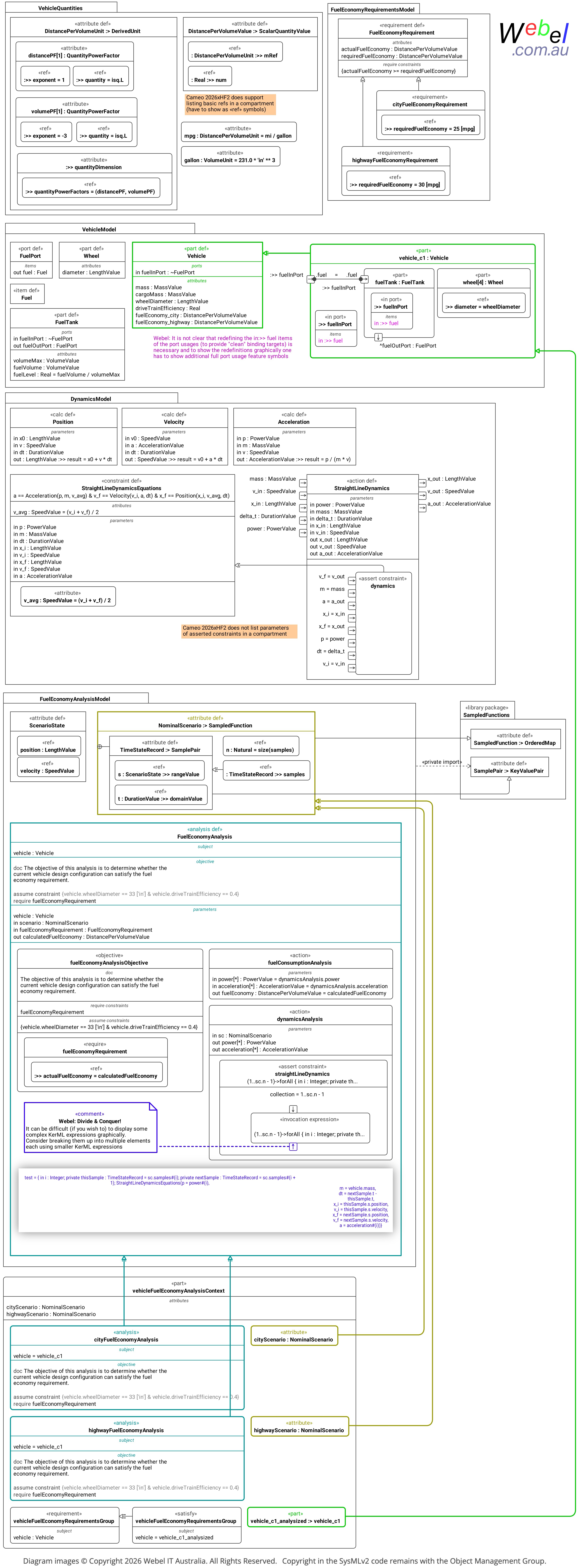
Analysis Examples: Vehicle Analysis Demo.sysml

Gallery
Tutorial
Offered by Webel free to the SysML community with thanks to the contributors of the SysMLv2 GitHub code examples. All diagram images remain © Copyright Webel IT Australia 2026. Copyright in the linked GitHub source code remains with the OMG. So-called "AI" and Machine Learning training systems DO NOT have permission to use (scrape and steal) this resource! Other training organisations DO NOT have permission to use these images in their own training.
Members of the OMG Systems Modeling Community (SMC) are welcome to use these images with full attribution to Webel IT Australia in presentations and non-commercial activities of the SMC – please unedited and using full resolution downloads (click on image first then Save As).
This slide trail is NOT a SysMLv2 language tutorial! Slides here are offered as is (some without further explanations) in the hope they may be of interest. To learn SysMLv2 attend the Webel SysMLv2 Seminar Workshop group course. Individuals may instead purchase access to the Webel SysMLv2 Online self-study eLearning course with self-test Quizzes to learn at their own pace.

Obviously it's not a good idea to use a single View diagram for such a complex system on your real projects! It's done here just to capture this sample in on diagram, and is clearly a candidate for Divide & Conquer strategies:
Click on the image to view it full size

Modelling: It's noteworthy that within vehicle_c1 the in port usages are redefined as :>> fuelInPort each with the directed item in :>> fuel redefined, which provides a "clean" binding target for the fuel. It's not clear (based on some other samples) that this redefinition of the directed features is necessary, and the only way to currently show graphically that the fuel redefinitions have been done is to show the full feature symbol for each redefined port usage.

(The proxy notation showing the .fuel on the binding connector is convenient, but it happens to not show whether a proxied connection end feature is inherited or not, so one can't tell from just that alone.)

In any case, presumably the interpretation is that the fuelInPort of the vehicle and the fuel tank each have a distinct physical manifestation, therefore it is not the ports that are bound, but just the fuel item they carry. One might, for example, wish to model safety features of provision of the fuel to the vehicle (fuel cap etc.) using the distinct port of the vehicle, separately from the inlet to the fuel tank.

Note also:

Up next
Next trail section
Notes
Snippets (quotes/extracts)
Related slides (includes other tutorials)
Related slides (backlinks, includes other tutorials)
Visit also
Visit also (backlinks)
External links